
I spent 25 years in the military before I became a coach.
When I finally made the pivot at 42, I did what most coaches do.
I got certified. I built a website. I posted content. I waited.
Nothing happened.
Not because I lacked skills. Not because I lacked passion. But because I was building a coaching business the wrong way — starting from the outside in, instead of the inside out.
After years of working with coaches across Egypt and the Gulf, I’ve seen the same pattern repeat itself. Talented people. Real expertise. But no clear system connecting who they are to the clients they want to serve.
So I built one.
Here are the 6 steps that form the foundation of every successful coaching business I’ve seen — and the order matters more than most people think.
Step 1: Clarity — Know Yourself, Your Problem, and Your People
Everything starts here.
Before your brand. Before your content. Before your pricing. Before any of it.
Three questions that must be answered with precision:
Who are you? Not your credentials — your real story, your lived experience, the turning points that shaped how you see the world and help others.
What problem do you solve? Not a broad, vague category. A specific, painful, felt problem that real people are actively looking for help with.
Who are you solving it for? Not “anyone who needs coaching.” A specific person, in a specific situation, with a specific goal.
Most coaches struggle to get clients because they skip this step. They jump straight to marketing a message that was never clear to begin with. You can’t amplify what you haven’t defined.
Clarity isn’t a nice-to-have. It’s the foundation every other step is built on.
Step 2: Brand Story — Build Deeper Connection Through Who You Are
Credentials open doors. Stories walk through them.
Your potential clients don’t just want a qualified coach — they want a coach they trust, relate to, and believe can actually help them. That trust is built through story.
Your brand story answers the question your audience is silently asking:
“Why should I listen to you?”
Not with a list of certifications. With the real arc of your journey — the challenge you faced, the transformation you went through, the insight you gained, and why it makes you uniquely positioned to help the people you serve.
My story is a 25-year military career followed by a complete reinvention at 42. That story isn’t a footnote in my brand — it is my brand. It signals to mid-career professionals and coaches that I understand transition from the inside, not just the theory.
What’s your story? What experience shaped your coaching perspective in a way no textbook could?
Find that. Build from there.
Step 3: Framework — Create the Model That Powers Your Transformation
Here’s where the real intellectual work happens.
A framework is the structured methodology that explains how you take a client from where they are to where they want to be. It’s the “how” behind your coaching — made visible, repeatable, and teachable.
Why does it matter?
Because without a framework, you’re just having conversations. With one, you’re delivering a system. And systems are what clients pay premium prices for.
Your framework doesn’t need to be complex. It needs to be clear.
It should have a name. It should have defined stages. It should be something you can draw on a whiteboard in under two minutes and have a client immediately understand what working with you looks like.
The BrandOS model I built — 6 steps, sequenced deliberately, each one building on the last — is a framework. It allows me to explain my work, package my services, and teach other coaches how to build theirs.
Your experience already contains a framework. The job is to extract it, name it, and make it visible.
Step 4: Program Design — Turn Your Framework Into a Product
A framework in your head is a concept. A framework in a program is a product you can sell.
This is where transformation becomes tangible — for you and your client.
Program design means taking your framework and turning it into a structured journey: defined sessions, clear milestones, specific outcomes at each stage, and a timeline that creates accountability and momentum.
A well-designed program answers four questions your client has before they ever ask them:
- What will I get?
- How will we get there?
- How long will it take?
- How will I know it’s working?
Coaches who can answer these questions clearly close more clients, charge more confidently, and deliver better results — because the structure itself creates the container for transformation.
Design your program once. Refine it with every cohort. But start with something real and structured — not a vague “it depends on the client” offering.
Step 5: Offer Design — Build Your Pricing and Revenue Streams
This is where most coaches leave serious money on the table.
An offer is not a price list. An offer is a complete package — the outcome, the experience, the access, and the price — that makes the decision to say yes feel obvious.
Pricing your coaching is not about what the market will bear. It’s about the value of the transformation you deliver.
Strong offer design also means thinking beyond one-to-one sessions:
- Group programs that scale your time
- Digital products that generate passive revenue
- Workshops and corporate training that open B2B markets
- Retainer packages that create predictable monthly income
The goal is not to have one product at one price. The goal is a revenue ecosystem — entry points, core offers, and premium tiers — that matches different client needs and stages of commitment.
Your expertise is worth more than hourly sessions. Build it into offers that reflect that value.
Step 6: Content Planning — Build Authority and Drive Sales Strategically
Content is not the starting point. It’s the amplifier.
Once you have clarity, story, framework, program, and offer — your content finally has something real to say.
Strategic content serves two functions simultaneously:
It builds authority — positioning you as the go-to expert in your niche through consistent, valuable, perspective-driven posts, articles, videos, and conversations.
It drives sales — creating the awareness, trust, and desire that moves the right people toward your offer at the right time.
The mistake most coaches make is posting randomly — sharing tips and quotes with no connection to their offer, their audience, or a content strategy that actually leads somewhere.
Strategic content is planned. It maps to your offer. It speaks directly to your ideal client’s specific problems. And it creates a trail of evidence that you are exactly the person they’ve been looking for.
One post will not build your business. A consistent content system — built around who you are and what you do — will.
The Real Problem Isn’t Hard Work
Most coaches I’ve met are working hard.
The problem is that they’re working hard on the wrong things, in the wrong order, without a clear system connecting all the pieces.
These 6 steps — Clarity, Story, Framework, Program, Offer, Content — aren’t six separate projects. They’re one integrated system. Each step makes the next one stronger. And skipping any one of them creates a gap that no amount of marketing can fill.
Ready to Build Yours?
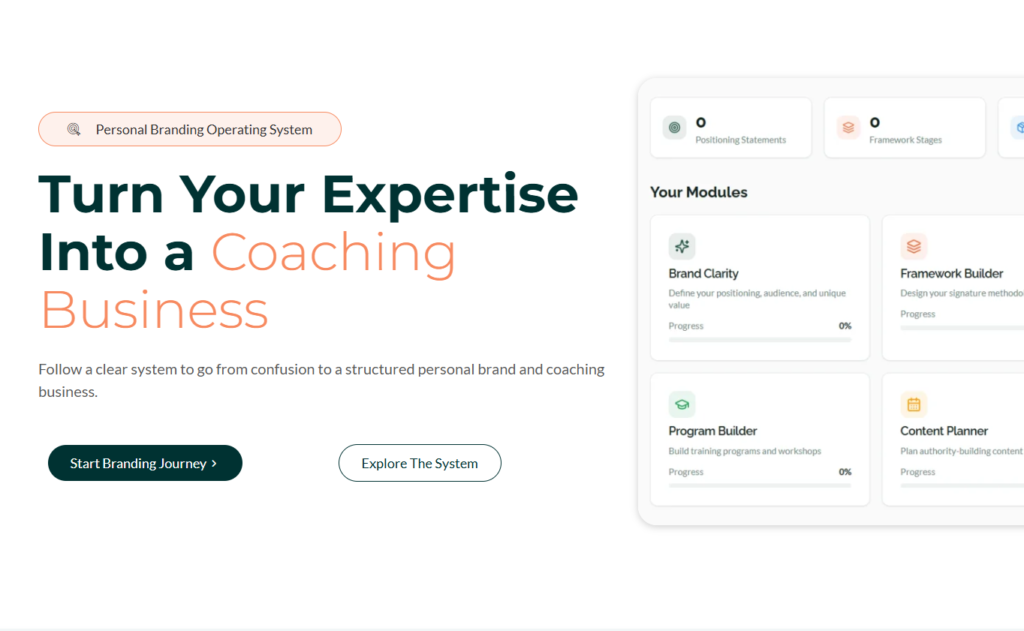
I built BrandOS — a 6-tool digital system at https://nextephub.com/platform — specifically to guide coaches through each of these steps with structure, clarity, and real tools that produce real output.
Not another course. Not more theory. A hands-on system that walks you from “I have expertise” to “I have a business.”
→ Start building at https://nextephub.com/platform
Or DM me directly — I’m here to help you figure out where you are in this process and what your next move should be.